Skills.Standards.Safety.Scale.
01 — Overview
The grid can wait. Skills cannot.
- Taught on live equipment, not slides
- Solar PV, battery, inverter and safety
- Certified against practical competencies
- Delivered on site or at our centre
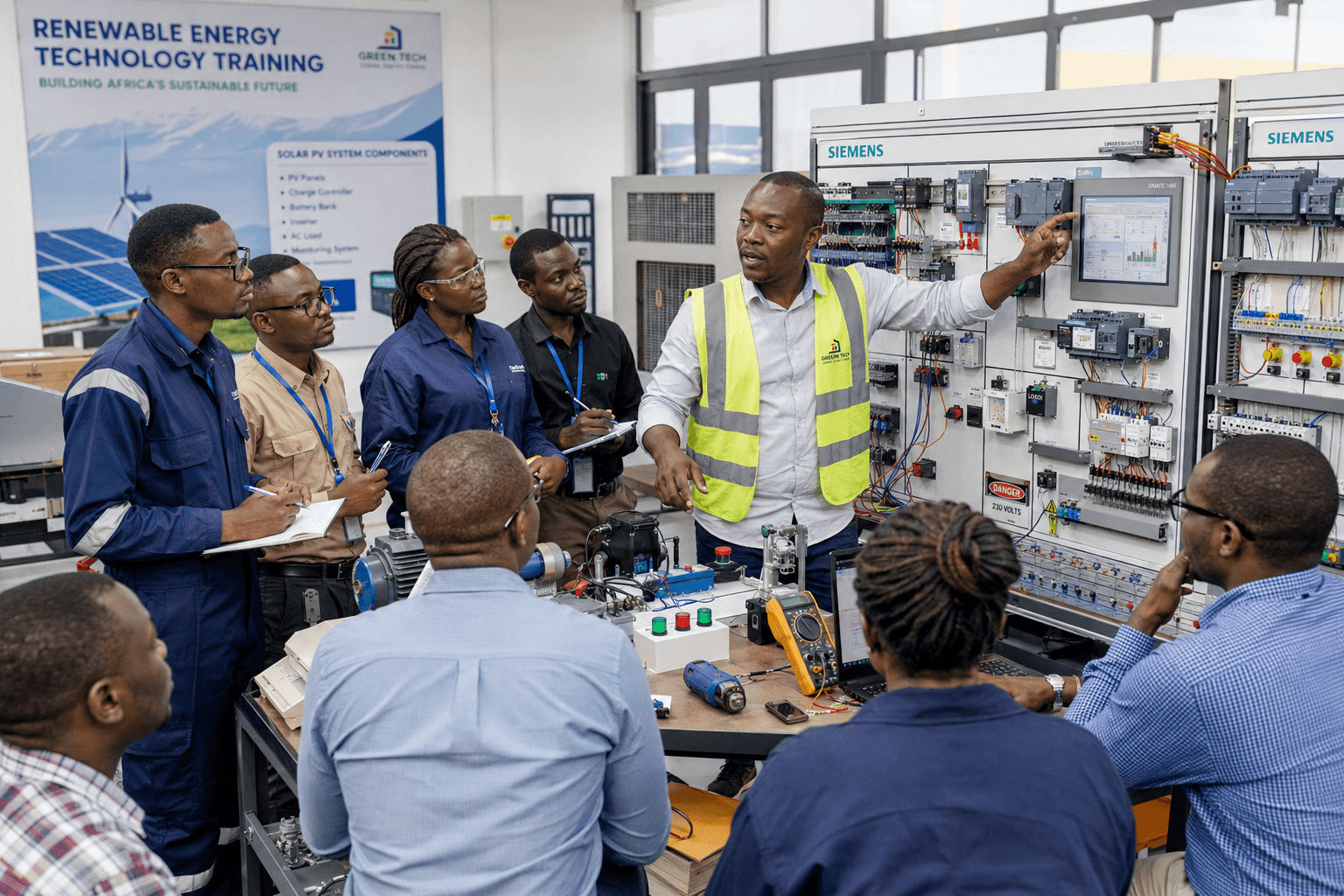
Practical, hands-on training for technicians, engineers, facility teams and organisations — covering solar PV design and installation, battery and hybrid inverter systems, electrical safety, and system operation and maintenance. Every module is taught by working engineers on live equipment, and assessed against what a trainee can actually do with a meter in their hand, not what they can recall in a written paper.
Africa’s clean energy transition is not held back by hardware; panels and batteries arrive faster than the skills to install them safely. The bottleneck is competence — and a badly installed system does more damage to the sector’s reputation than no system at all. We built this programme to close that gap. Trainees move from first principles to a commissioned array: sizing a system against a real load profile, selecting components that will still be available in five years, mounting for genuine wind loading, terminating DC correctly, setting protection, and proving the installation with an insulation resistance test rather than an assumption. Battery and hybrid inverter work is taught with the same rigour, including the fault diagnosis that separates a technician who can install from one who can be trusted to return alone. Safety runs through everything — DC arcs do not extinguish themselves at zero-crossing the way AC does, and that single fact reshapes how a competent installer works. Programmes run at our centre or on your site, and can be scaled from a single facility team to a cohort of contractors.
02 — Our experience
Taught by the people who install it
- engineers as instructors
- Workingengineers as instructors
- equipment, not simulators
- Liveequipment, not simulators
- competency assessment
- Practicalcompetency assessment
- or at our centre
- On-siteor at our centre
We teach this because we do this. Every instructor on the programme is a working engineer from our own installation teams, not a career trainer — the person explaining why a string fuse matters was terminating one last week, and can tell you what goes wrong when it is skipped. That matters more than it sounds: the trainee sees the discipline of somebody who is professionally accountable for the system they commission, and picks it up by imitation as much as instruction. Our curriculum is drawn directly from installation records, so the failures we drill are the ones our engineers actually encounter in the field — the shading study that was skipped, the DC connector crimped with the wrong die, the earthing that was assumed rather than tested. We assess by observation on live equipment, and we are willing to fail a trainee, because a certificate that everyone passes is worth nothing to the employer who relies on it.
03 — What’s included
What the programme contains
Solar PV design & installation
System sizing, component selection, mounting, DC and AC wiring, protection and commissioning to recognised standards — taught on live installations, not slides.
Battery & hybrid systems
Configuring and troubleshooting hybrid inverters, charge controllers and lithium battery banks, including safe handling, fault diagnosis and firmware setup.
Electrical safety & standards
Working safely with DC and AC, earthing, protection coordination, isolation and compliance — the foundation every competent installer needs before touching a roof.
Operation & maintenance
Monitoring, preventive maintenance routines, performance verification and fault-finding, so teams can keep systems producing long after handover day.
04 — Why it pays
Why it pays to train with us
Competence you can verify
Assessment is by observation on live equipment against practical competencies, so a certificate reflects what a technician can do, not what they memorised.
Fewer callbacks, lower cost
Most system failures trace back to installation, not hardware. A properly trained team removes the rework, the warranty disputes and the reputational damage.
Safety that holds up
DC faults behave nothing like AC. Teams trained on real arcs, real earthing and real isolation protect themselves, your client and your liability position.
In-house independence
Facility teams that can run and maintain their own systems stop paying for a call-out every time an inverter shows a code they have not seen before.
A local skills base
Every technician trained lowers the delivered cost of clean energy in the region and shortens the wait for a competent installer.
Curriculum from the field
Content is drawn from our own installation records, so trainees drill the failures our engineers actually meet — not textbook scenarios written elsewhere.
More of our services
Our Services · Advisory
Energy Audits
Find exactly where the money is leaking — then stop it.
Our Services · Operations & Maintenance
Maintenance
The savings you were promised only arrive if the system keeps working.
Our Services · Supply & Support
Electrical Spares
The right part, in your hand, before downtime costs you a shift.
Our Services · Engineering
Fabrication
Built to spec, built to last — the steelwork your energy systems stand on.
Our Services · Rotating Equipment
Pumps & Motors
Keep the water moving and the line turning — repaired, not just replaced.
Our Services · Safety & PPE
Safety
The right protective gear on every worker, on every site, in every discipline.
Ready to lower your energy bill?
Get a free assessment and a costed proposal with a clear payback period.